Research Proposal
Research Overview
My project idea:
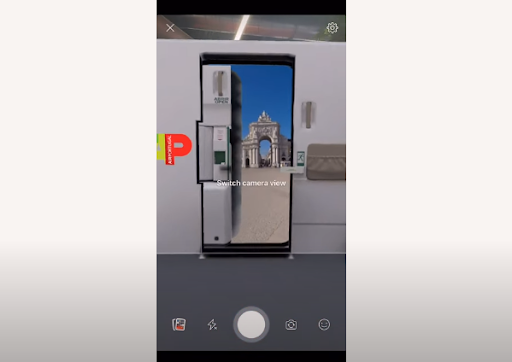
My proposed idea is for an AR experience catered towards helping people with agoraphobia. Using Unity, I would like to create ‘portals’ to the outside world, where users can then explore at their own pace, with the goal of reducing anxieties and fears of the outside world. To create the ‘outdoor world’, I will use a combination of Google Maps 3D Tiles and Blender to create realistic scenes mimicking outside locations. I will also implement sound effects to add an extra layer of realism.
Objectives of my experience:
- To provide a realistic representation of the outside world through lighting, sound, motion and visual techniques
- To help people suffering from Agoraphobia, creating a safe and comfortable experience in which they can go at their own pace in accordance to their personal preference.
- To help agoraphobic people to conquer their anxieties and fears, giving them a sense of control over the experience.
Concept Research
What is Agoraphobia?
Agoraphobia is a fear of situations where it may be difficult to escape if something were to go wrong. According to the NHS website, Agoraphobia can manifest in multiple forms, including a fear of leaving the house, a fear of public transport, or a fear of open spaces. (NHS, 2024).
This can result in panic attacks, which may have an impact on one’s mental health, social life and general wellbeing.
Currently, the most common treatment for Agoraphobia is exposure therapy paired with lifestyle changes and self help methods – such as breathing techniques. (NHS, 2024).
Recently, the NHS have approved of a new form of treatment which uses Virtual Reality to allow users to practice entering everyday experiences, such as leaving the house.
First trialed at Oxford University, researchers said that VR therapy “led to significant reductions in anxious avoidance of, and distress in, everyday situations compared with usual care alone.” They added: “The mediation analysis indicated that the VR therapy worked in accordance with the cognitive model by reducing anxious thoughts and associated protective behaviours…gameChange VR therapy has the potential to increase the provision of effective psychological therapy for psychosis, particularly for patients who find it difficult to leave their home, visit local amenities, or use public transport.” (NICE, 2023)
Although this new technology is very beneficial and impactful, it currently isn’t readily available. As of September, 2023, more than 1.8 Million patients were on a waiting list for NHS mental health services (NHSProviders, 2023). Additionally, current waiting times for therapy on the NHS are estimated to be between 6-18 weeks depending on location, severity and the type of service (NHS, 2024).
As a result, I think a mobile based AR experience could be beneficial for those waiting to receive help. Users can access the service whenever they like and can go at their own pace and control. Being able to access the service from home may also be comforting as they are more likely to feel safe and can quickly remove themselves from the situation.
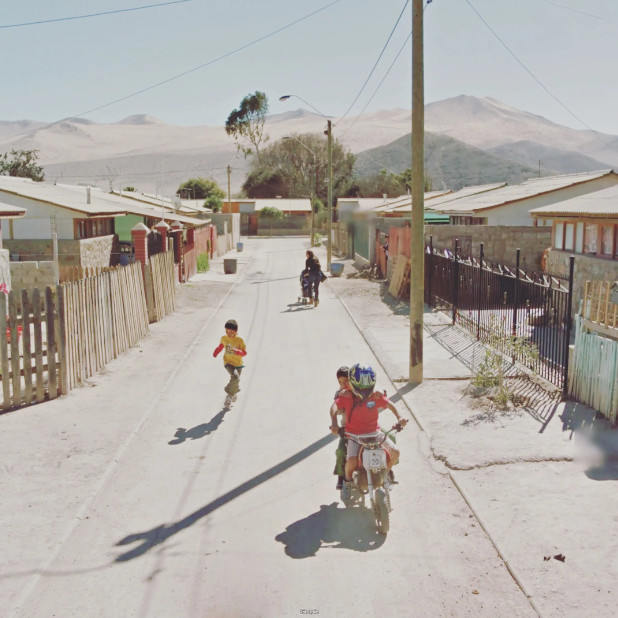
One example which has inspired my project is the work of photographer Jacqui Kenny.
A New Zealand based photographer, Jacqui Kenny uses Google Maps to capture screenshots from around the world. She developed this technique as a result of her Agoraphobia, which allowed her to become a successful travel photographer with over 130K followers on Instagram. She has worked alongside Google to create immersive 360 narrated photographs, in which she imagines the stories behind her digital travels. (Google, ND)
‘Agoraphobia and anxiety limit my ability to travel, so I’ve found another way to see the world.’ (Kenny, ND)
AR Portals
“Through the camera of their smartphones, users can see a “doorway” that leads them into a virtual world. They can then move freely and look around the scene as if they were in a “real” place. AR portals can have photorealistic 360 spheres showing real-world locations or they can be completely digitally crafted into a number of imaginary worlds.” (RockPaperReality, 2022)
AR portals are a fast growing concept which are being used in a multitude of ways to enhance how users interact with both the real world and the digital world. By combining the two, users can explore digital spaces as if it were 3D. For example, some E-commerce brands have been using this technology to create unique user experiences through the use of ‘digital showrooms’ which the user can walk through and browse as though it were a physical store.
AR portals are also being used within the tourism industry, creating a more convenient travel experience. “Tourists can access information about their destination and area while they explore through their smartphones. Travelers can use AR to find restaurants, bars, shops, transport, activities, and hotels making navigation in unfamiliar areas quicker, more convenient, and personalized.” (Truyols, 2023) Because of this, I believe a similar experience could be useful in aiding agoraphobic people, creating a sense of security and familiarity before they go somewhere new, reducing worries and concerns.
User Centered Design
User Perspective
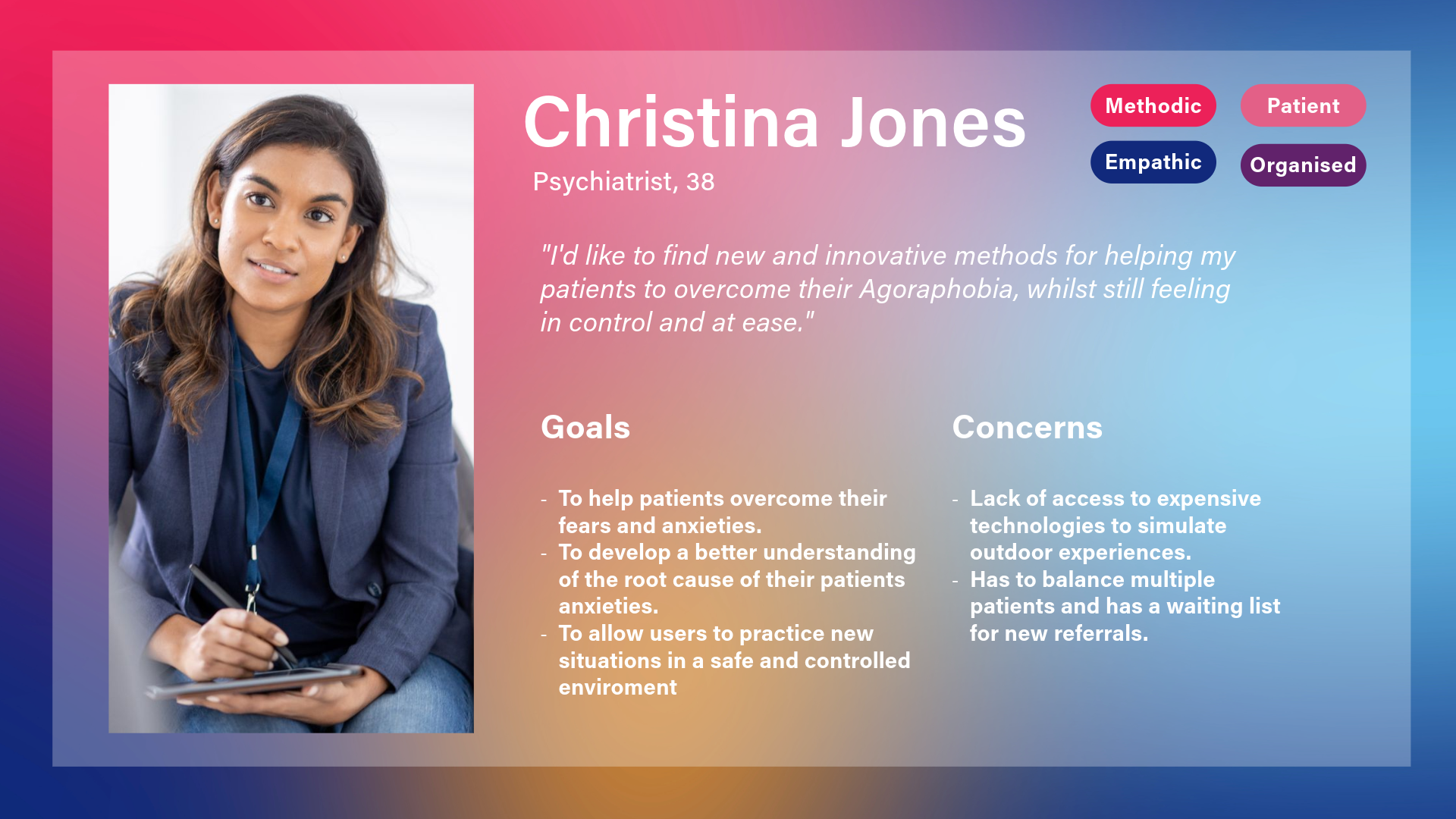
“I am a psychiatrist specialising in treating patients with agoraphobia. I would like to offer my patients with new self-help methods which allow them to gradually ease themselves into new situations simulating the real world.”
User Research Perspective
Psychiatrists want to offer new and alternative solutions to typical therapies whilst still allowing the user to feel safe and in control of their experience.
Four W's
Psychiatrists (who) are looking for new ways to aid agoraphobic patients (what) to allow them to overcome their fears and anxieties (why) from their own comfortable spaces (where)
User Perspective
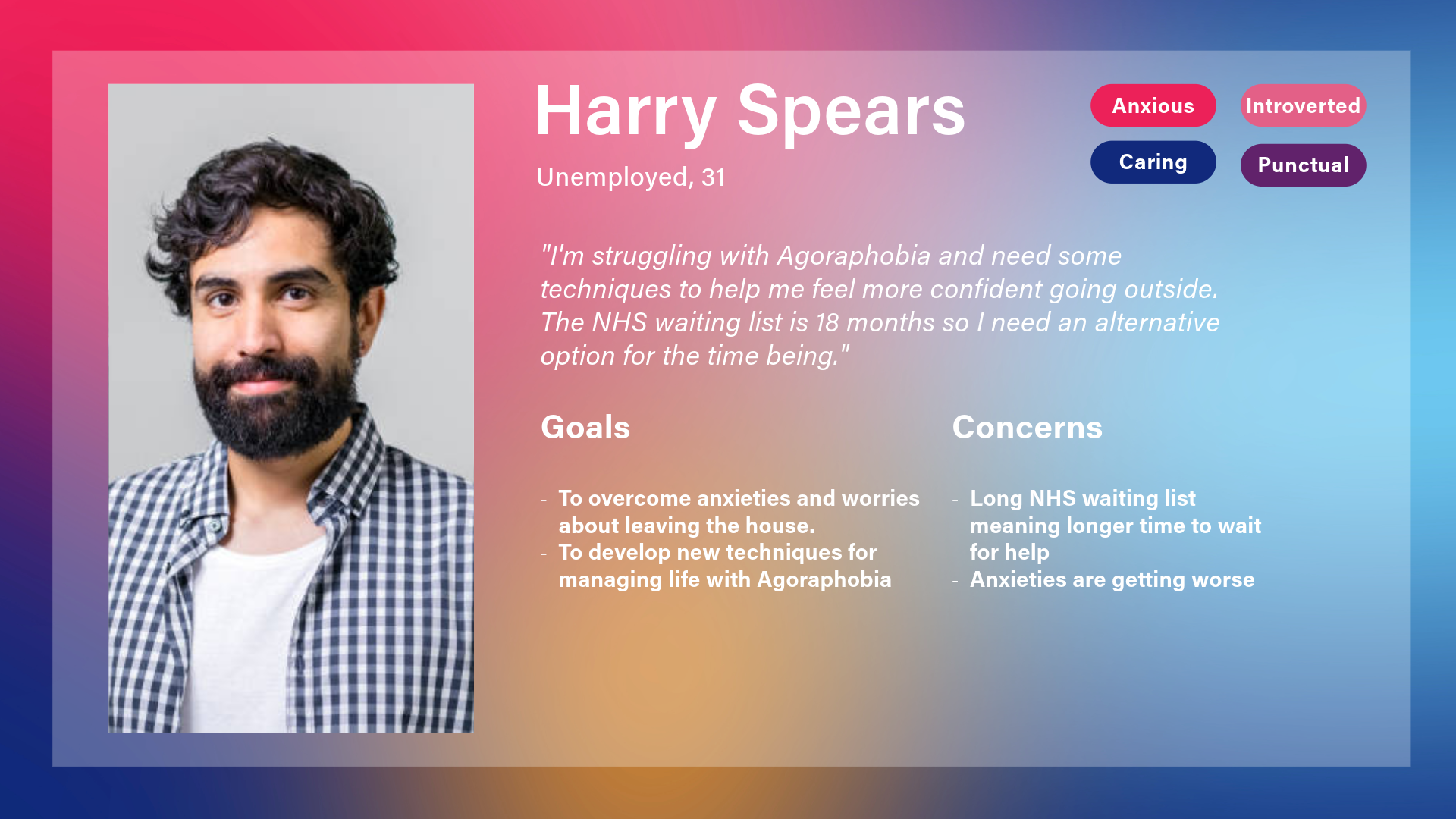
“I am somebody who suffers with agoraphobia and I am currently seeking treatment. However, I am currently on a long waiting list and would like to explore self-help techniques in the meantime.”
User Research Perspective
People with agoraphobia are having to wait long times to be referred to a psychiatrist, and need alternative methods which allow them to relieve their anxieties and phobias.
Four W's
People with agoraphobia (who) would like new self-help methods (what) at home (where) to manage their anxieties whilst waiting for referral to a professional (why)
To better understand my users and their individual needs from this AR experience, I have created user personas to help outline goals and concerns for my project. I have also considered their needs from both a user perspective and a research perspective as a better way of knowing what will be required of my experience.
Content Development
There are a few components to my project, and I will have to use a range of software to produce my experience.
Firstly, I will need to create a 3D environment which replicates the real world. To do this, I intend on using the Google Maps 3D Tiles API, which I can either bring into Blender or straight into Unity. Not only does this save time spent modelling accurate scenes, but it is the most accurate representation of the environments I want to capture.
Once I have set up the scene, I will want to add moving objects and motion to bring it to life. In the real world, there’s always something happening whether it be cars, pedestrians passing, animals or other day-to-day occurrences. It is important to be as realistic as possible so users can get an accurate representation, resulting in proper progress. To do this, I will use Blender to create moving assets such as vehicles, people and animals. Additionally, I could download assets online but I would like to balance this with my own assets for originality.
Similarly, I will also need to consider sound and audio within my experience. I would like to experiment with spatial audio using AudioSource configuration in Unity. This will add a layer of depth and immersion into the experience, which will also be beneficial for users.
And lastly, this will all be brought together within Unity, where I will form the ‘portal’ effect to the experience. I plan on using a door to introduce the scene, so the user feels like they actually are stepping outdoors. To do this, I will be following along from a range of tutorials from YouTube
Story Telling and Narrative
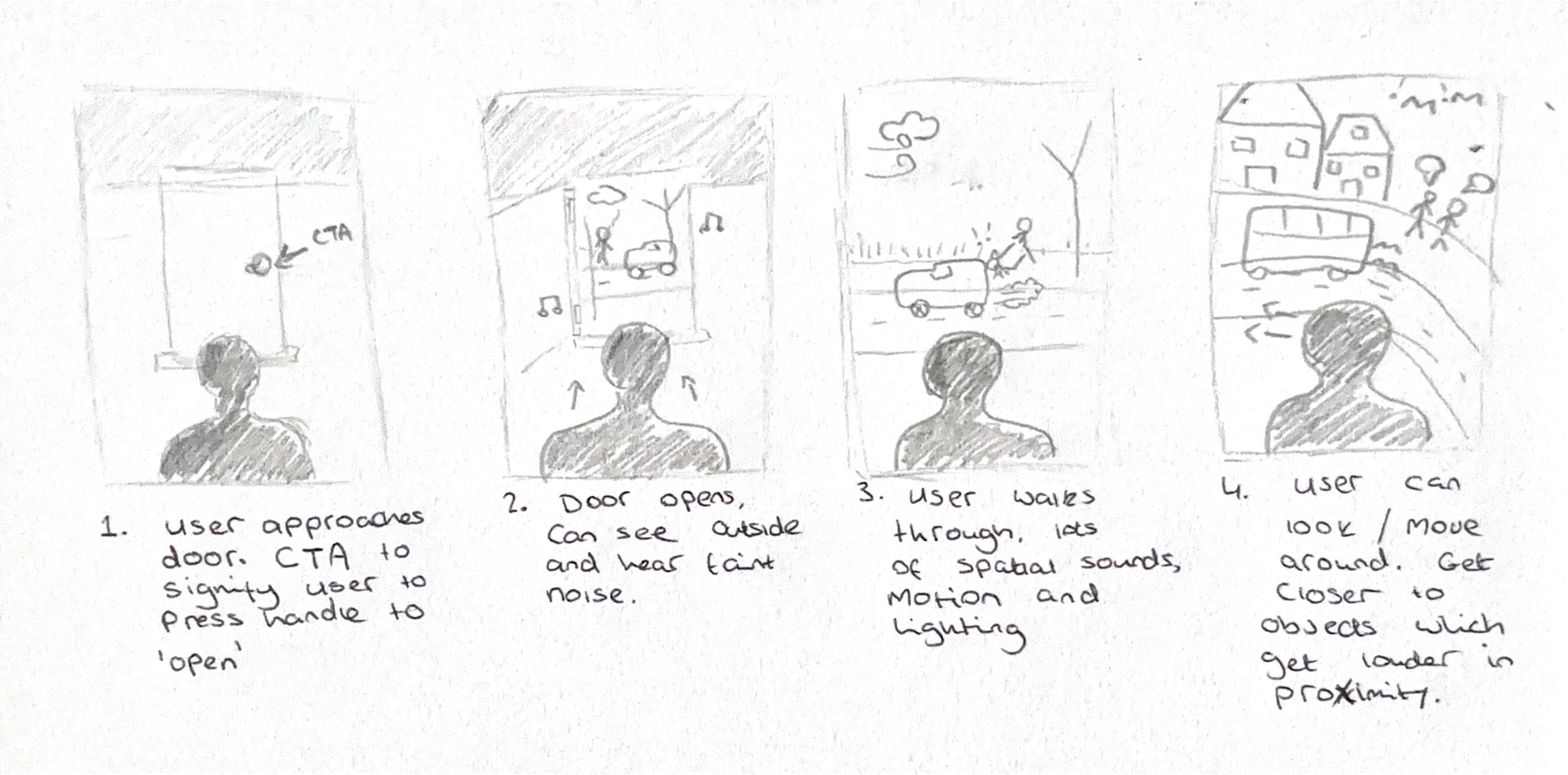
AR experiences rely on ‘presence’ within storytelling, meaning the user actually feels as if they are ‘there’ in the scene. In the ‘real world’, we are constantly experiencing with all five senses, so my experience needs to combine as many of the senses as possible.
The most obvious is sight. Adding visual cues can help to push a narrative and can encourage the user to take action and engage with the scene. Use of colour, form, shape and size can help guide the user indirectly – especially when used to indicate CTAs such as buttons. You could also be more explicit by using shapes such as arrows to direct the user on where to go, but it is better to allow the user the feeling of choice and free will.
The user will also be able to move around as if they are in the scene. The 360 camera allows them to look around and become fully immersed within the experience, and gives them the freedom to explore, looking and moving in the direction that they wish to.
Sound can also be incorporated and can also direct the user on where to go or what action to take. For my experience, I will use spatial audio to create depth within the scene and to encourage the user to explore and interact. Some sounds will gradually increase in volume depending on how close the user is to the source, making the scene more realistic.
Being able to interact with the scene gives the user a better sense of presence. Because of this, I intend on adding interactions, such as the ability to ‘open’ the door to the scene by tapping it on the mobile screen.
Considerations
There are a few things which I must consider when creating my AR experience to ensure compatibility and user accessibility.
- Device compatability:
Device compatibility is something I will consider for my production piece. Older mobile phone models do not support the viewing of AR models, so I must consider the inclusivity based on this fact. For Apple, devices require iOS 11 or later and an A9 chip model or later, whereas Androids require Android 7.0 or later. IOS 11 was released in September of 2017, and Android 7.0 was released the year prior – meaning users with models which were released before 2016/17 will not be as likely to view the experience.
- Display Size and Surrounding Environments: Mobile screens are more narrow, meaning there will be a shallow range of sight when viewing the experience. It is important to optimize for mobile screens and to design the scene with this in mind. Additionally, it is important to consider how much space the user may have in the real world, and how this may affect how far they can explore the scene. Additionally, it is important to consider how the experience will integrate with the real world – for example, if someone walks past the user’s device as they are ‘inside’ the portal, will that affect the immersivity? This could be avoided by optimizing the experience to allow sensors to detect objects for occlusion – newer iOS models for example, use an A12 chip, which supports occlusion. However, older devices won’t have this feature, which could affect the users sense of presence.
- File Size: Because users will be viewing the experience through their mobile device, it is important to keep the file size as low as possible to optimize loading times, performance and accessibility. Both iOS and Android typically recommend 10-15mb for files such as Adobe Aero. It is also important to consider where the user will be using the experience – does it have a strong connection or signal? Keeping file sizes smaller will make it easier for users to access the experience at any time or place.
- Psychological Impact / User Comfort Agoraphobic users may feel overwhelmed if the space is too extensive / there is a lot going on. It would be better to create smaller spaces with less going on at a time to not overwhelm inexperienced users. As users become more comfortable, experiences could become larger and more detailed to accommodate to their needs / comfort zone levels. Users should feel like it is easy to leave the experience if it is too overwhelming and feel okay to do so without guilt or shame. To make this clear, I could add a disclaimer at the start of the experience which explains that it’s okay to take a break or leave if it becomes too overwhelming.
- Visual Cues: Some users may become anxious when first entering the experience as they could be unsure of where to go. Adding some cues to direct the users around the experience could be useful so users don’t feel nervous with the lack of direction on what to do or where to go. This could be done by adding arrows or even a ‘tutorial’ which walks the user through the experience at first, but later grants them the freedom to explore as they’d like once they feel more confident.
Milestones / Project Management.
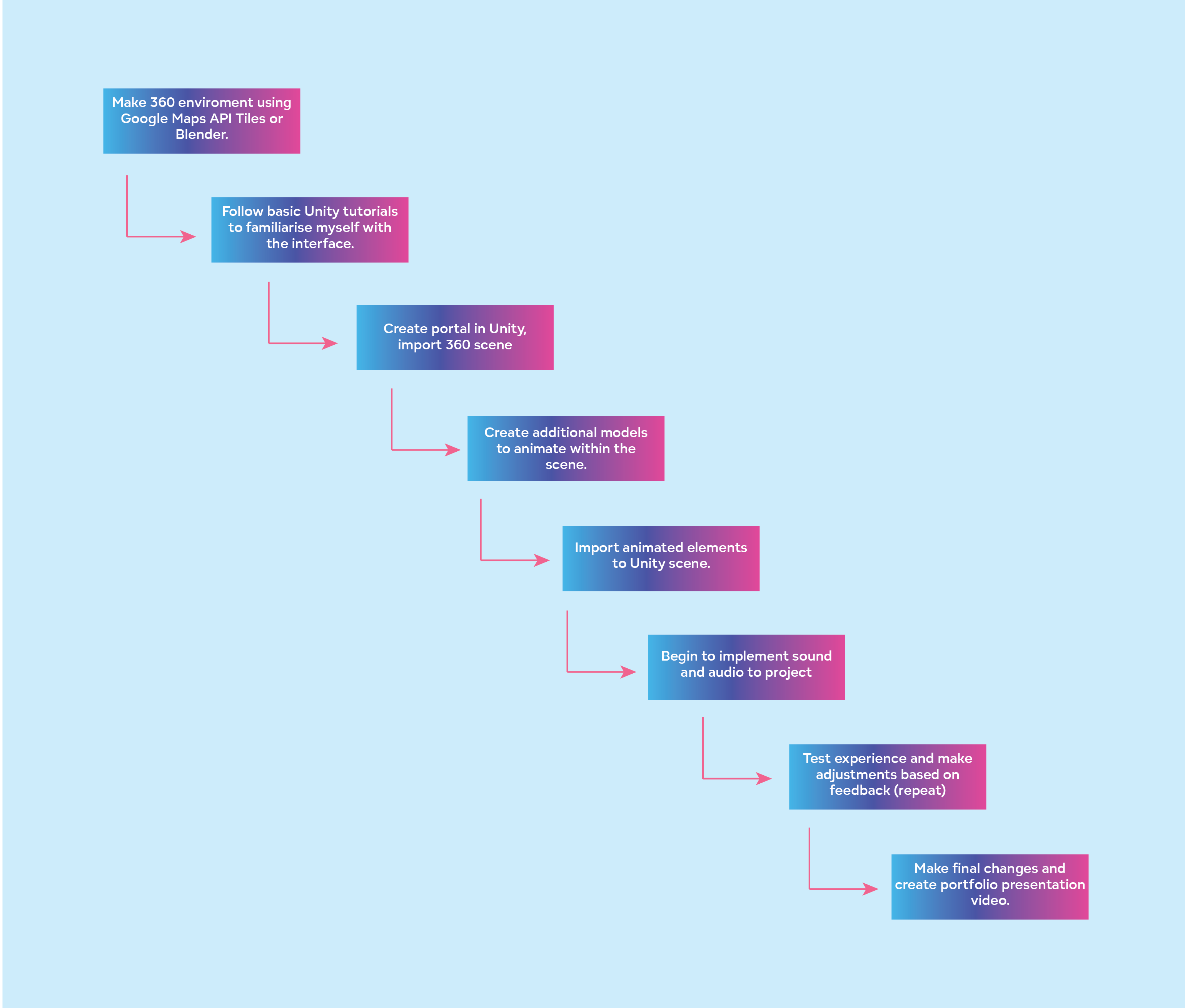
I have broken down my project into steps to make it easier for me to manage what I need to do and the best order in which to approach it. I have used a waterfall methodology to produce a linear sequence in which I will approach each task. Additionally, I will be working in scrum-teams to present my progress each week to a group of people, meaning I will be receiving a constant stream of feedback throughout my process. I will keep a record of these team meetings to track feedback and progression on a week by week basis.
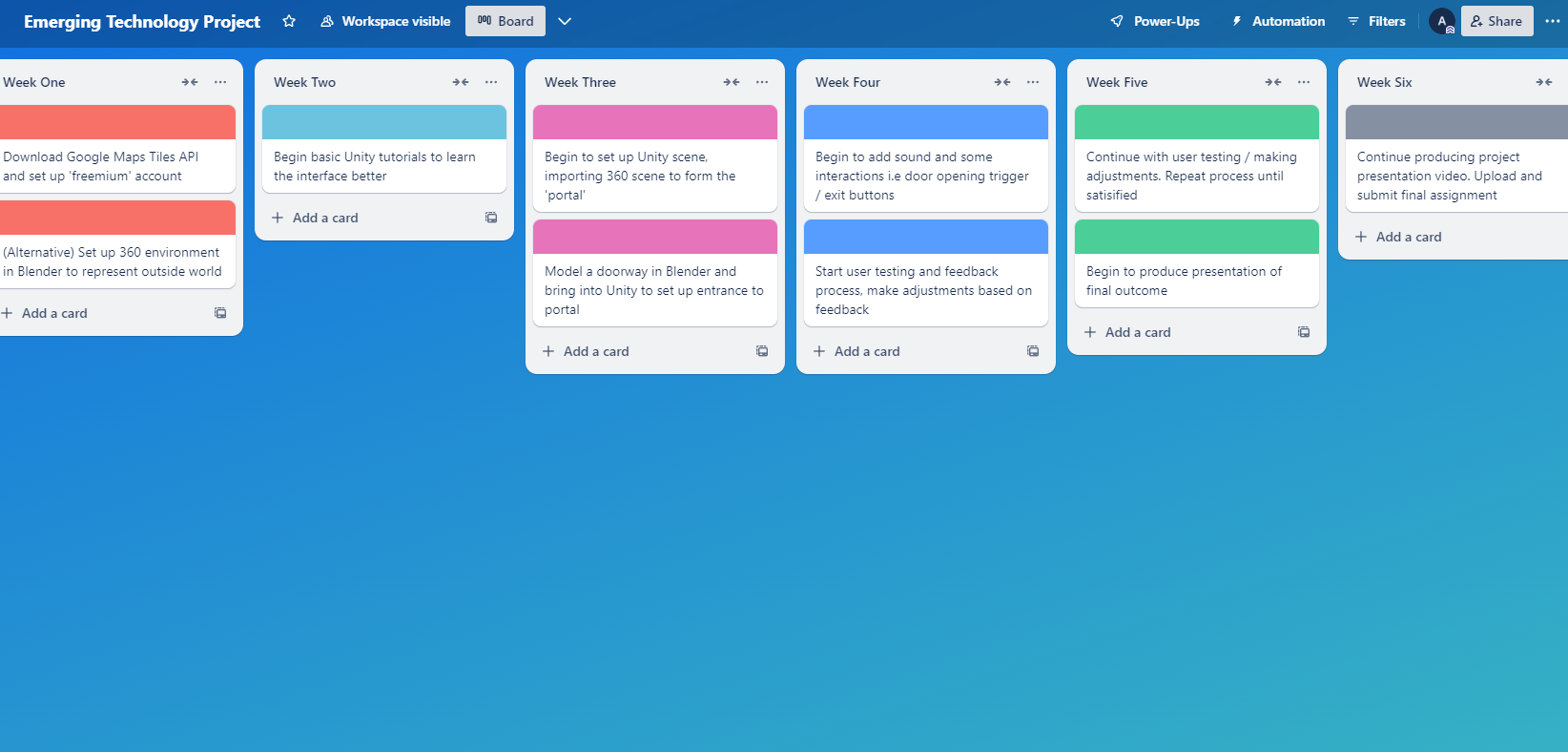
To aid with time management, I have created a Trello board which breaks each task down week by week and allows me to tick off what I have completed and set deadlines for each individual task. This will help me to work efficiently and breaks the work into smaller, more manageable phases which contribute toward the final production.
References:
GDT Solutions (2023) How to GET 3D SOUNDS in Unity – AudioSource configuration [Video]. Available online: https://www.youtube.com/watch?v=9g9Pf_Z5hhY [Accessed: 25/10/2024]
GettyImages (ND) Psychiatrist [Image]. Available online: https://www.health.com/psychiatrist-7371773 [Accessed: 25/10/2024]
Guidev (2018) AR Portal Tutorial with Unity – ARCore Setup – Part1 [Video]. Available online: https://www.youtube.com/watch?v=g78hQB8UKEM [Accessed: 25/10/2024]
Google (ND) The Agoraphobic Traveller [Article]. Available online: Can Google Maps help an isolated artist unlock a world she never knew? Go deeper into episode 5 of the Search On docuseries. – Google [Accessed: 25/10/2024]
Google (2017) The Agoraphobic Traveller | Men in green 360° [Video]. Available online: https://www.youtube.com/watch?v=0hD61q-h9kA [Accessed: 25/10/2024]
iStock (nd) 30 Year Old Man [Image]. Available online: https://media.istockphoto.com/id/1139722168/photo/mid-adult-man-smiling-on-gray-background.jpg?s=612×612&w=0&k=20&c=fLgqnldmSlNHU-fooFM1dlyF4Fo1gqx8yDJsmkz-AHw= [Accessed: 31/10/2024]
Kenny, Jacqui (2017) Sharjah, United Arab Emirates [Image]. Available online: https://www.wired.com/story/magical-striking-scenes-from-google-street-view/ [Accessed: 28/10/2024]
Kenny, Jacqui (ND) The Agoraphobic Traveller [Quote]. Available online: Can Google Maps help an isolated artist unlock a world she never knew? Go deeper into episode 5 of the Search On docuseries. – Google [Accessed: 25/10/2024]
LexaRozz (2023) The ENTIRE WORLD in 3D inside of UNITY| Google Maps 3D Tiles to Unity TUTORIAL [Video]. Available online: https://www.youtube.com/watch?v=lLw5hCqSv5Y [Accessed: 25/10/2024]
NHS (2024) Overview – Agoraphobia [Article]. Available online: Overview – Agoraphobia – NHS [Accessed: 25/10/2024]
NHS (2024) Service standards [Article]. Available online: NHS England » Service standards [Accessed: 25/10/2024]
NHSProviders (2023) NHS Providers responds to call for long term mental health plan [Article]. Available online: NHS Providers responds to call for long term mental health plan – NHS Providers [Accessed: 25/10/2024]
NICE (2023) NHS approves virtual reality treatment for severe agoraphobia [Quote]. Available online: https://futurecarecapital.org.uk/latest/nhs-approves-agoraphobia-vr-treatment/?gad_source=1&gclid=CjwKCAjwg-24BhB_EiwA1ZOx8nbkac5QU9xNcOR6aHWQbdsFcYLjGt61hbTtq3CXgGQQSK7AA7nPFRoCyJkQAvD_BwE [Accessed: 25/10/2024]
PoplarStudio (ND) TAP Airlines portal into Lisbon [Image]. Available online: https://poplar.studio/blog/how-augmented-reality-travel-is-changing-tourism/ [Accessed: 31/10/2024]
Truyols, Marc (2023) 5 Ways Augmented Reality is Enhancing the Tourism Experience [Article]. Available online: https://mize.tech/blog/5-ways-augmented-reality-is-enhancing-the-tourism-experience/#:~:text=Tourists%20can%20access%20information%20about,%2C%20more%20convenient%2C%20and%20personalized. [Accessed: 26/10/2024]